
Global consumer (B2C) and business (B2B) experiential marketing spending grew 8.3% to $138.94 billion in 2025 and is on pace to post accelerated growth of 10.3% in 2026, as one of the advertising & marketing industry's largest sectors benefits from an even-year cash infusion driven by the Winter Olympics, FIFA World Cup and record political media spending in 13 of the world's top 20 media markets, according to new research released today by PQ Media, the world's leading provider of media econometrics.
STAMFORD, Conn., June 9, 2026 /PRNewswire-PRWeb/ -- Global consumer (B2C) and business (B2B) experiential marketing spending grew 8.3% to $138.94 billion in 2025 and is on pace to post accelerated growth of 10.3% in 2026, as one of the advertising & marketing industry's largest sectors benefits from an even-year cash infusion driven by the Winter Olympics, FIFA World Cup and record political media spending in 13 of the world's top 20 media markets, according to new research released today by , the world's leading provider of media econometrics.
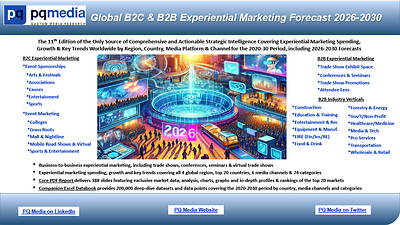
PQ Media's 11th biennial covers the 2 major experiential marketing sectors (B2C and B2B); 2 B2C and 4 B2B experiential channels; and 11 B2C and 13 B2B experiential categories (see more details in the About the Report section below).
B2C experiential marketing was the larger of the two industry sectors, increasing 7.7% to $97.24 billion in 2025, and is on pace this year to post the fastest growth in a decade at 10.9%, fueled by the spending of official sponsors of the Winter Olympics, FIFA World Cup teams and the contentious mid-term and other political campaign races in the majority of the top 20 global markets, according to . In particular, the political hotbed in 2026 is in the world's biggest experiential market – the United States, where internal and external political tensions, as well as the wars in Iran and the Ukraine, and the political infighting related to the redrawing of congressional districts in several key states ahead of the mid-term elections in November has created a cauldron on the campaign front that is expected to produce record political media spending through next fall.
Meanwhile, B2B experiential marketing grew faster than its B2C counterpart in 2025, rising 9.7% to $41.74 billion, although it's pacing to grow at a slower rate than B2C experiential in 2026, posting an 8.9% gain. Fueling B2B experiential growth is an increase in exhibit booth rentals, as fees increase due to the tariff wars and trade show promotions that are becoming more elaborate, such as VIP invite-only sessions with well-known industry leaders and influencers serving as speakers, panelists and MCs.
In the B2C experiential sector, consumer event sponsorships was the larger of the two major channels at $50.25 billion in 2025, with the sports sponsorships category being the largest at $33.5 billion, commanding a 66.7% market share. Live consumer event marketing was the fastest growing B2C channel, up 8%, with sports & entertainment events being the largest vertical category at $19.04 billion, accounting for a 40.5% share.
Within B2B experiential marketing, exhibit space rental fees was the largest channel at $25.71 billion in 2025 and was also the fastest growing of the four B2B channels, up 10.1%. Conferences, seminars & virtual shows was the second largest channel, while trade show promotions was the second-fastest growing. Entertainment & recreation was the largest of the 13 vertical categories at $5.34 billion, a 12.9% market share, with healthcare & medicine; forestry, mining & energy; and media & technology also posting double-digit market shares.
"Experiential marketing is a vital part of marketing campaigns because of its ability to offer one-on-one engagement with consumers that most other media platforms can't offer. In the B2C sector, event sponsorship growth is being driven by new venues accepting sponsorship deals, like sponsored messages in sports arenas, floor spaces, and uniforms. Live consumer event marketing is growing faster than consumer event sponsorships because it gives brands exclusive access to target consumers, particularly younger demographics at concerts, malls, college campuses and nightclubs," said . "Both B2C and B2B experiential marketing have increased consumer engagement by using technology incorporated into booth manufacturing that offer more interactive experiences through artificial intelligence, virtual reality, augmented reality, touchscreens, and 3-D displays. As mobile screen time continues to rise and in-home entertainment reaches saturation points, brands are increasingly focused on live experiences where attention is undivided and premium options are offered, such as VIP seating, high-quality screens, and smart-technology driven venues."
The US market, the world's largest, grew 9% to $64.43 billion in 2025, commanding 46.4% of global spending on experiential marketing. Partly due to the ongoing war with Ukraine, Russia posted the slowest growth at only 1.3%. B2C experiential marketing was the larger of the two sectors in the US at $47.8 billion in 2025, though B2B experiential grew faster, up 10.3%. Event sponsorships was the larger of the two B2C channels at $23.92 billion, while live consumer events grew faster, up 11.1%. Sports was the largest of the six event sponsorship categories at $16.98 billion, while sports & entertainment was the largest of the five consumer event marketing categories at $9.48 billion. Meanwhile, exhibit space rentals was the largest of the four US B2B channels at $10.11 billion in 2025, as well as the fastest growing, rising 10.8%. Entertainment & recreation was the largest B2B vertical category, reaching $2.41 billion in 2025, according to the .
Going forward, US experiential marketing is on pace to grow 11.8% in 2026, fueled by sponsors and live viewing events associated with America's participation in the Winter Olympics and its tri-hosting of the FIFA World Cup along with Canada and Mexico. Political rallies and campaign spending are expected to surge during this year's mid-term election cycle, as states battle to redraw congressional district maps, geopolitical tensions continue and socioeconomic conflicts fulminate. PQ Media analysts foresee multiple growth opportunities for event marketers, sponsors, developers and back-end designers again in 2028 when the US hosts the Summer Olympics.
About the Report:
PQ Media's 11th biennial covers the 2 major experiential marketing sectors (B2C and B2B); 2 B2C and 4 B2B experiential channels; and 11 B2C and 13 B2B experiential categories. Site licenses to the new Forecast include both a PDF Report, delivering 388 slides of datagraphs and analysis covering every country, sector, channel and category, as well as in-depth profiles of the top 20 global markets; and an Excel Databook, providing over 50 spreadsheet tabs with 200,000+ datapoints covering every major market, sector, channel and category worldwide for the entire 2020-2030 period. Click the report link above to download a FREE Executive Summary and Sample Datasets from the new Forecast report.
This year's Forecast includes the most detailed data breakouts and analysis of the B2C sector by its two experiential channels – event sponsorships and live event marketing – and deep-dive data on 11 key experiential categories within those two channels. The B2C event sponsorship channel covers sports; entertainment, tours & attractions; causes; arts; festivals, fairs & other events; and associations; while the B2C live events channel tracks sports & entertainment; virtual events & mobile road shows; grass roots; college campuses; and malls & nightlife.
The B2B sector is broken out by 4 industry channels: exhibit space rental fees; conferences, seminars & virtual shows; trade show promotions; and attendance fees. Also included in the B2B sector are data covering 13 industry vertical categories: construction & raw materials; education & training; entertainment & recreation; equipment & manufacturing; finance, insurance & real estate; food & drink; forestry, mining & energy; government & non-profit; healthcare & medical; media & technology; professional services; transportation & warehousing; and wholesale & retail.
About PQ Media:
delivers strategic intelligence, data and analysis to the world's leading media and technology organizations through syndicated market intelligence reports, custom drill-down research, and expert witness testimony. PQ Media uses a proprietary econometric methodology to define, segment, size, analyze and project the growth of several hundred traditional, digital and alternative media by country, sector, platform, channel and demographic. The company also publishes the annual , a three-report series in which each report focuses on one of three industry KPI's – advertising & marketing spending; consumer media usage; and consumer media spending.
Media Contact
Patrick Quinn, PQ Media, 1 2039215249, [email protected],
SOURCE PQ Media


Share this article